Saturday, 17 November 2018

Birding contrasts

Apologies once again for delays in posting - what with an amazing trip to India and catching up on things since getting back, it's been a bit busy!

I've not had too much time to get outside in good old Blighty recently, but one visit to Langford Lakes Reserve (just north of Salisbury on the A36) made me compare with the extraordinary wildlife I'd seen in India.

Although the primary goal was to see tigers (6 tigers and many, many photos later..), the birdlife was quite incredible. The bird list has not yet been totted up, but certainly over 70 species were seen. However, it wasn't so much the diversity, but the behaviour of several species that really got me thinking. In particular, the treepie - an extremely common corvid (crow), with the usual inquisitive nature you associate with that family. They are also extremely beautiful. It draws the inevitable comparison to our own magpie. How many of us stop and watch them and admire their gorgeous colours? It's interesting that a trip to faraway lands has made me stop and look at our commonest species back home.


And so it was at Langford Lakes - we took great delight in watching the various species of duck there. OK, it's not a tiger, but once you spend time watching something, you almost feel a part of its world. The lakes are known for their overwintering wildfowl, and now is the time for them to gather. We saw lots of gadwall (smart males with their black tails) and shoveler (strange beaks a little like the baleen plates of whales for feeding on microscopic life), but also many, many Canada geese and cormorants.

And it was Canada geese that beautifully caught the golden afternoon's light on another quick foray to Caen Hill Locks near Devizes last weekend. Although primarily visiting the amazing feat of engineering that are the many locks, the large noisy, groups of geese in the holding ponds couldn't help but attract attention. And although they're not native and are often a bit of a nuisance, you've got to admire their smart plumage and jostling antics.

So, when I'm out walking next, I'll be taking the time to stop and admire the commonplace. And to end this post, here's a tiger (wot I took).


Monday, 8 October 2018

Fabulous fungi

Apologies for the delay in posting - I've been busy with family gatherings, which have also featured getting outdoors, thus generating material to post about! Basically, it can be summed up as: fungi.

Yes, autumn is very much upon us - although the leaves are only beginning to change, the fungi have burst out of the ground/wood, bolstered by the wet weather we've been having.

Having visited Langley Wood last month to check on the chestnuts (not yet ready) and the fungi (ditto), I put it down to the dry weather. Now, having visited various New Forest ancient woodlands, and a quick foray to Purbeck to visit family, the great diversity of fungi is very much on display.

My favourite is a beautiful mushroom called a 'bolete' - this large and distinctive family are short, fat, and often interestingly coloured, with no gills under the cap - only pores. This particular one is - we think - Boletus luridus. However, my mushroom book dates from 1981 so I feel mycology may have moved on a bit since then! We first found this gorgeous species in Eyeworth wood in the New Forest, but we also found one growing beside the main track in Grovely Wood, and a lovely large one in Mark Ash Wood (New Forest again). Having never seen any like this before, there is speculation that the dry summer followed by late wet conditions, may result in some rare fungi making an appearance. Could this be the reason for spotting it?


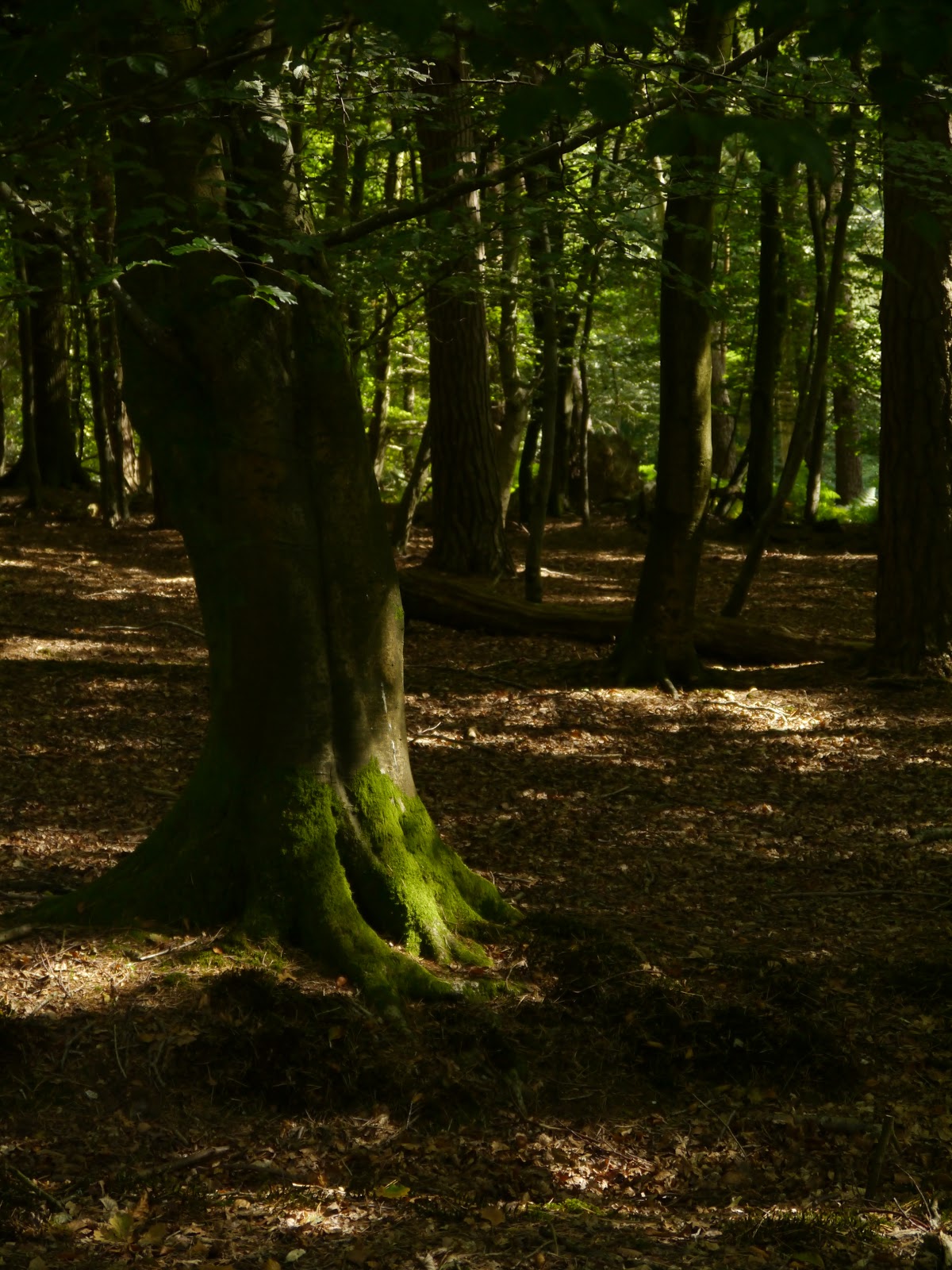
I asked a friend in the know, which bits of the New Forest were best for fungi - so we visited three ancient woodlands as a result (Eyeworth, Mark Ash, Red Shoot). As well as the fungi, the gnarled beech and oak, twisted sweet chestnut (must not collect any more...), quite a lot of fungi fruiting bodies appeared to be associated with old stands of holly, which I'd not seen before - well, you don't tend to get old stands of holly for a start!


Although a lot are edible, collecting of fungi is strictly forbidden in the New Forest, as they are one of the reasons the site is legally protected and internationally important for wildlife.  What we often see is the fruiting body of the much larger subterranean organism, producing spores to spread far and wide in the woodland, so collecting these could reduce the numbers seen in the future. Many fungi are associated with particular species of tree, forming 'mycorrhizae' with the tree's roots, forming a sort of nutrient swap benefiting both.

I much prefer to take a few pics (OK, a lot of pics) and leave for others to enjoy. So if you see anyone picking them, let the Forestry Commission know.

Tuesday, 18 September 2018

Early autumn spectacles

Although the sun maintains intermittent bursts of summer, wildlife is already welcoming autumn.

I'm lucky enough to live very close to a colony of ivy bees - these are currently a southern specialty, having only recently colonised (as of 2001) the UK, although they're spreading north. They're fairly unique in emerging from their underground burrows in September - the males emerge first, having pupated underground, forming great swarms ready to pounce on females that emerge later. At the moment, the slope down to the River Avon path is abuzz with them in great numbers. The females do sting but as most of the insects are males (non-stinging) and they're all far to busy trying to find a mate, you can easily wander through or sit among them for a great close-up view of this interesting insect. They're called ivy bees as they feed on the nectar of the ivy flowers, which are a late bloomer and hence out now. Another reason ivy is a good thing!


This week I managed a quick walk around Martin Down - some flowers do still cling on, including harebells, and devil's bit scabious. But apart from that, it definitely had the feel of winding down for the year.


And then on Sunday we ventured into the New Forest, this time starting at the popular spot of Fritham. The Oak pub is excellent, but with the sun shining, we had packed our lunch instead, hoping to escape the crowds at this busy spot.

Navigation in the Forest is always tricky - made even harder by my out-of-date OS map. You might think not much happens to make a map inaccurate, but as the Forestry Commission- working with partners such as Natural England and the National Park - clear blocks of conifers, restore streams, and open up enclosures, suddenly landmarks have changed dramatically! All this meant that, although we had a lovely walk, taking in ancient woodland and open heathland, we did get slightly lost. Thankfully, our phone GPS got us back on track - just as well there was reception!


All of our meanderings led us to stumble (sometimes quite literally) upon several spectacular fungal displays. it's still a bit early - and a bit dry- so we were pleased with our finds! A large parasol mushroom (good to eat but even better to take photos and leave behind), some form of bolete (same family as porcini and possibly also good to eat, depending on the species!), as well as some amazing bracket fungi (possibly artist's palette). All of this made possible by centuries of lack of active management by humans, wood being left to rot where it is, and the livestock being free to wander and create unique microhabitats.


And all this at the start of autumn - more fungi please!


Saturday, 8 September 2018

Summer's last hurrah

I know, I keep going on about summer fading, but last weekend was beautiful and felt like it was trying hard to stick around!

We headed off to Old Winchester Hill National Nature Reserve, in the South Downs, for stunning views, some butterflies and fading flowers, and a yomp along part of the South Downs Way and Monarch's Way to the beautiful River Meon near Exton, then looped back. Although most of the flowers had gone over, the clumps of marjoram and scabious provided a last nectar source for the butterflies flitting about - small heath and meadow brown, but with a strongly-suspected sighting of an adonis blue too. It was very active, so I can't be certain, but from the bright azure hue, I can't think of anything else it could be (too bright for a common blue). They've declined dramatically over the decades, favouring south-facing slopes of short turf with horseshoe vetch - still some patches locally in the South Downs and Cranborne Chase thankfully. Our route took us next to a small overgrown pond, where we not only watched (or were being watched!) by a large, patrolling southern hawker dragonfly, but had a great view of a hornet too!


Not knowing what to do with a beautiful Sunday, we decided to brave a foray into the New Forest, to one of our favourite places, Bucklers Hard. despite the autojumble being on and filling the Motor Museum car park (!), the lovely footpath along the Beaulieu River to Bucklers Hard wasn't too busy at all. Last time we had completed the walk, there were signs warning us against attempting it, due to extreme flooding and mud, defying the lengths of boardwalk. We still did it, but yes, oh the mud! This time, not only was it very dry, but the sun shone on the sparkling water, as we watched boats pass by. Arriving in Bucklers Hard itself, it wasn't too busy there either, and we watched the sparrows in the bushes chomping on rose hips whilst we too chomped on our sandwiches. Even though it is a 'there and back' walk, I didn't mind at all, as the views were so gorgeous on the way back, with the sun still shining. We called into a tearooms for a bit of refreshment, to find an attached community garden called 'Paddy's Patch', filled with an abundance of fruit, veg and beautiful blooms, as well as another hornet - an excellent end to the day!


Saturday, 1 September 2018

Contrasts

Well that was an interesting Bank Holiday weekend! despite the horrendous weather, we did venture out on the Sunday, and enjoyed the contrasting dry weather on the Monday too.

Hearing that some friends had sneaked over to the UK from America for a break, and were relatively nearby, we braved the weather for the journey towards Farnham, where we were to meet for a late lunch. Our route passed by the Basingstoke Canal - could this be tolerable in the monsoon-like conditions?

The canal is actually a SSSI - quite unusual for a man-made feature - for its aquatic plants and insects. The section we explored started near the ruins of Odiham castle, just outside of Basingstoke itself. The castle was built between 1207 and 1214 for King John, and after years of being used for royal functions and a hunting lodge, was finally left as a ruin in the 17th century, where part of the site was destroyed during the construction of the canal. Now, what's left is free to explore.


Returning to the towpath, thankfully overhung with vegetation providing some shelter, I remarked on the clarity of the water and quantities of the aquatic plants for which it is so ecologically important. We spied several little grebes paddling among the copious amount of pondweed, and it was indeed nice weather for ducks. This stretch is mostly closed for navigation by narrow boats, allowing nature to take over. Our short route ended at the Greywell Tunnel - home to the largest hibernation roost of Natterer's bats in Europe, and itself a separate SSSI for this reason. Gated off due to collapse further inside, it would have required the boatmen to use their legs to move the boat along the long towpath-less tunnel. We just retraced our route back to the car, returning rather sodden.


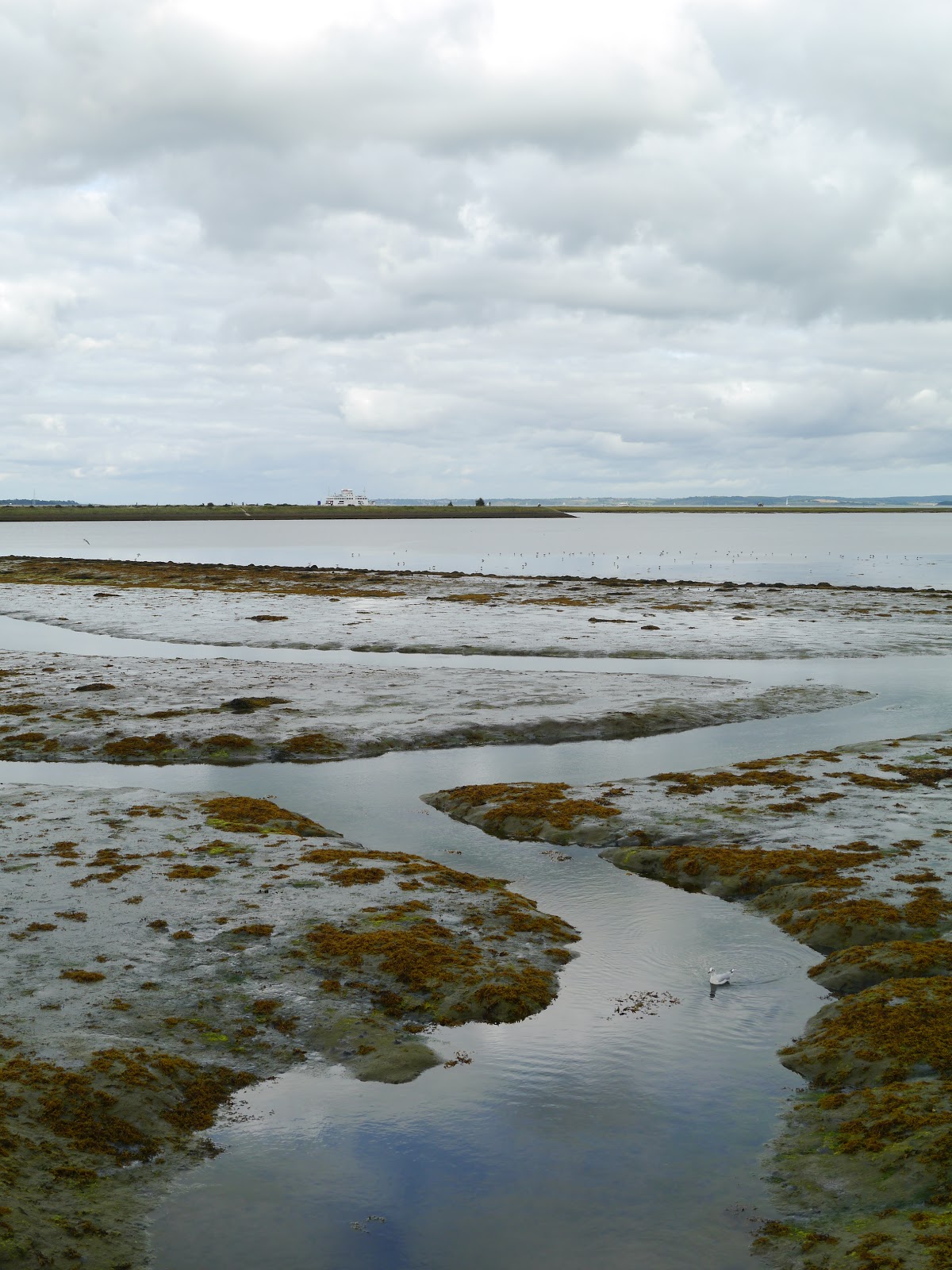
Sunday, as I say, was a bit of a contrast! We opted to explore Lymington via a walk from the Keyhaven Marshes on the New Forest coast. This is one of our favourite places - easy walking along the sea wall, great views across the marshes towards the Isle of Wight, and usually good bird life whatever time of year.


Visiting now isn't the best for birds - the summer breeders have finished and the winter migrants have yet to arrive - but we did spy lots of resident waders including lapwing, oystercatcher, dunlin, redshank and curlew, and had some great close up views of little egret fishing. Although our walk into Lymington was the same as the return, due to the turning tide, the views were completely different. As the tide went out on our way back, the waders started to get fidgety, gathering in small flocks, flying from inland feeding marshes to the newly-exposed mudflats full of tasty titbits. As autumn draws nearer, we'll start to see more waders arrive, including the chatty brent goose - something to look forward to despite the proximity of winter.