Saturday, 15 April 2017

Seizing the days

What an excellent coincidence - a week off timed with fabulous weather! I had a lot to pack in, but think I did rather well.

The weekend was a jam-packed series of social events, featuring a beautiful walk along the Wilts and Berks Canal from Melksham to Seend for lunch at The Barge Inn. The blackthorn blossom was out, the birds were singing, orange-tip butterflies were on the wing, and we were heading towards lunch - idyllic!


Then, on Monday, with the sun still shining, I headed off to Fritham for a walk with a friend. Deep in the New Forest, it is a hub for various routes through ancient woodland and heathland, with some particularly gnarly old trees along our path.

Tuesday I met up with another friend for walks in Botley Wood and along the Hamble. The former is a large area of mixed ancient and plantation woodland SSSI, with beautiful wildflowers along the rides and glades. It's under pressure from development at nearby Whiteley (on the edge of Fareham), and indeed, some of the (non-SSSI) fields earmarked for housing were a mass of cuckooflower - sad to know they'll be ploughed up in a few months. The bluebells, wood anemones and primroses were putting on a lovely display as we walked, accompanied by chiffchaffs, a nuthatch and various thrushes.

Our walk along the Hamble was a bit of a contrast - the tide was in, suspending the algal mats in the water - they  are a sign of nutrient enrichment and prevent the important colonies of wading birds from feeding. A lot of work is being done to reduce runoff from agriculture and improve sewage treatment, but there is so much more to be done. Despite this, it was good to see some oystercatchers and black-headed gulls feeding, and the various wrecks and mosaic of reedbed and saltmarsh habitat were very scenic.

On Wednesday, I finally managed to get out to Garston Wood - this is my favourite bluebell spot. A small RSPB reserve north of Sixpenny Handley, it can get rather packed at peak bluebell season. I arrived at 10am, with the place deserted. The bluebells were a beautiful spectacle and yet still perhaps a week or so away from their peak. I extended my walk north out of the reserve into other patches of ancient wodland, following the Dorset/Wiltshire county boundary, and encountering the remains of a fort. The ramparts were a mass of ramsons (not yet in flower) and the surrounding land a carpet of bluebells - such a marked demarcation, so interesting to see and no doubt going to be beautiful when the flowers are at their best. I meandered down through part of the Rushmoor Estate, with lots of work being done in their woodlands to open them up - carpets of primrose and wood anemone were the result. I then returned to the reserve, photographing my favourite old mossy stumps and noting the first ramson flowers coming up. Fingers crossed I can revisit in a few weeks for their display. On my drive back I was able to have an excellent view of a red kite flying low over the road adjacent to the reserve - if the walkers I was passing had only looked up, so would they!

Thursday was a day of chores and seeing friends (although I did see another couple of red kits on my journeys!), but yesterday I headed off with my parents to Wherwell in the Test Valley for a lovely couple of walks around Chilbolton Common and Harewood Forest. Although the weather wasn't as nice as previous days, it was still dry and actually the flatter light made for better photography. Our morning walk crossed west down nature reserve - an area of chalk grassland slowly being restored, and where I spotted my first cowslips of the year.

In the afternoon, we headed up into Harewood Forest. It's a large area of mixed ancient woodland and plantation - not a SSSI, it is largely carved up into blocks and narrow strips of woodland bordering arable fields. Nevertheless, pockets of wildflowers remain, although it was interesting to see these bluebells were much further behind than at Garston. There was also evidence of hybridising with the non-native Spanish bluebell - these are the familiar ones in gardens, taller stems, wider leaves, no scent, flowers not drooping on one side, and blue pollen. On our way back I did see my first swallows of the year - a couple perched in a tree looking a bit knackered, unsurprisingly given their mammoth journey from Africa! And again, on our way back we had a fabulous view of another red kite - they seem to be everywhere at the moment. What a brilliant story of recovery.

Fingers crossed the weather continues to hold up for this Easter weekend, as I'm hoping to visit another one of my favoured bluebell haunts on Sunday - Langley Wood NNR.


Sunday, 9 April 2017

'I expect a view'

This week has been simply glorious, and unfortunately I've spent most of it indoors in meetings! However, there were a few notable exceptions.

After work on Monday, I managed to head off early, and was back in time for a lovely late-afternoon walk from mine along the Avon Valley Path - the air was alive with birdsong including a very vocal bullfinch. It's odd, but I've never really noticed them much until this year, when they seem to be everywhere! A beautiful bird to view, with its pink breast and black cap, and very insistent call.

Then, on Wednesday and Thursday, I was in a two-day management team meeting - ugh you might think, but no, this was held on Chesil Beach (or at least, in the lovely visitor centre there). For those who don't know, it's a long bank of shingle connecting the mainland at West Bay to the isle of Portland. It used to be thought to be a tombolo (a beach connecting an island) but my A Level geography has had to be updated as research has shown that it was once a barrier beach (isolated out i the channel) that has rolled backwards to join the land with Portland. Really fascinating. plus, it is home to a wealth of wildlife - little tern nest on the shingle, and the sheltered lagoon behind (the Fleet) is home to a variety of waders and wildfowl, as well as various rare plants found only in this unique habitat.


You get great views when driving up to Portland - subject to some Olympics cash - back towards the beach - on the beautiful sunny spring days we had, it looked like a tropical paradise, with the thermals off the ridge being caught by a kestrel nearly at head height. Bliss.

Then, yesterday I was walking along the Wilts and Berks Canal from Melksham to Seend in more glorious sunshine, marvelling at the reflections of the blackthorn blossom  and once again accompanied by the chiffchaffs, skylarks and other birds calling around us. Have we been lulled into a false sense of security in that this sort of weather might last? Well, i'm off work this week for a bit of local pottering, so you can pretty much bank of the weather breaking tomorrow - sorry everyone!

Sunday, 2 April 2017

Rivers and wildflowers

Spring is really starting to hot up now - and quite literally! Last Sunday it was about 19 degrees - perfect for our post-Mothering Sunday meal walk along the Itchen Navigation.

Although busy, we were able to enjoy the beautiful river (actually a canal created for barging produce up from Southampton) and associated wildlife - the gnarly old trees overhanging the water were beautiful in particular. The banks were festooned with blackthorn blossom and celandines - gorgeous.

On Friday I called it a day from work early and headed up to Clarendon park - the ruins of the old hunting lodge were being weeded as I passed by, llamas looking on, and crossing into the ancient woodland. Here, I found toothwort (parasitic plant on hazel), primroses, wood anemone, dogs mercury and violets. All the while accompanied by skylarks, chiffchaffs, and a bullfinch. 

And I've just got back from a delightful day in the Test valley, walking parts of the Test Way and surrounding arable fields, including Harewood forest and it's beautiful ancient woodland flowers. I love this time of year - bluebells were just starting to come up so I'm hoping for a brilliant spectacle in a couple of weeks' time.


Sunday, 26 March 2017

Spring sunshine

Haven't the last few days been beautiful? I've tried to make the most of it!

Last Sunday I met a friend on Martin Down - it was blowy and overcast, but hearing the skylarks, yellowhammers and a bullfinch, together with spotting the hairy violets flowering, made for a beautifully atmospheric walk. Spring is certainly here.

And this week I've managed a few evenings of walks from the flat along the Avon Valley Path - the benefit of the longer days. All the trees are in bud and the bushes are bursting into leaf with that vibrant green characteristic of this time of year. The low evening sun casts spectacular shadows and backlights delicate natural forms of reeds and brambles - common species whose beauty is often overlooked.

Let's hope this weather continues for a bit, but of course, it is England...


Saturday, 18 March 2017

Free!

Last weekend I had my uni housemates and husbands over, and decided to show them the ultimate free way to see Stonehenge!

Apparently, the extortionate cost of paying to see the stones up close and enter the visitor centre (which I am told is excellent) is to offset other English heritage properties/sites that make a massive loss due to restoration costs. Nonetheless, this walk takes you through the historic landscape with excellent interpretation along the way.

We started at the Woodhenge carpark - here you get an excellent view of the scale of Durrington Walls - a large circular banked enclosure - and the not-so-impressive Woodhenge. This is basically a set of post holes filled with short pillars of concrete to give an impression of their positioning. In reality, they reckon the wooden posts would have been several metres tall.

Moving on, we crossed a meadow filled with singing skylarks above us, and moved onto the dismantled railway. The route then took us behind the posh officers' houses at the barracks before the Cursus came into view.

This point is marked with an information board, marking the astonishing scale of the earthwork - the end of it can't be seen from this position. It was probably a banked enclosure for ceremonial purposes but we can't be sure - part of the mystery of the place. We crossed the Cursus and several more fields, all with skylarks and sheep, being under the management of the National Trust. We could see the stones in the distance, but the undulations of the land meant it came and went from view several times. No doubt, this was planned to add to the mystery. Arriving at the stones via the Avenue processional route, we were able to get great views without paying a penny! This is thanks to the closure of the old A344, now restored to grass to reconnect the landscape. We returned via some cordoned off (to allow grass to recover) bowl barrows and crossed the Cursus (although we only realised it when we looked to the horizon!) before heading back the way we had come. In the summer, the meadows are full of wildflowers and a range of invertebrates too.


The next day we walked into Salisbury centre via the Avon Valley path - something I had not yet done despite living in the area for 5 years! The start is the usual route either to Old Sarum or to the Stratford Reserve (which was looking very sad having had no management for yet another year), but we carried on along the extensive boardwalk and then into Salisbury itself. A kingfisher was spotted and the first chiffchaffs of the year were practicing their songs. It was a surprisingly easy walk, and didn't take us that long to get into town - something I'll definitely do more of in the future.


Saturday, 4 March 2017

Old Ground

Last Sunday we were wracking our brains for somewhere to walk that wasn't going to be too muddy (after all that rain), which was relatively sheltered (due to the wind!) and somewhere a bit different. I thought a potter along the Avon Valley might be interesting, starting off on very familiar ground!

We parked up just off the A338 outside what used to be The Hourglass restaurant (now an Indian), right next to my old school 'The Burgate'. The start of our route really got the memories firing up - it was our cross country course. It started off through a farmyard (following the Avon Valley Path) and out onto watermeadows. Back in my day, the farm was a dairy - consequently, the yard was absolutely disgusting. I remember carefully picking my way through the excrement, only for fellow runners to come full-pelt through and splash me - ugh! Nowadays, the farmer has closed his dairy and diversified - holiday cottages, willows for cricket bats and beef cattle. Several years ago I tried to persuade him to come into a Higher Level Stewardship (HLS) scheme - although I wasn't successful at the time, clearly he needed more time to think it through and did eventually come into the scheme, safeguarding this area for wildlife.

Once through the yard and crossing the meadows, you start to see a ridge ahead of you as the gravel terraces making up this massive floodplain come into view. Here, the river is wide and meandering, providing ample habitat for a variety of wildfowl, although when we visited there were only swans! there were, however, also no people!

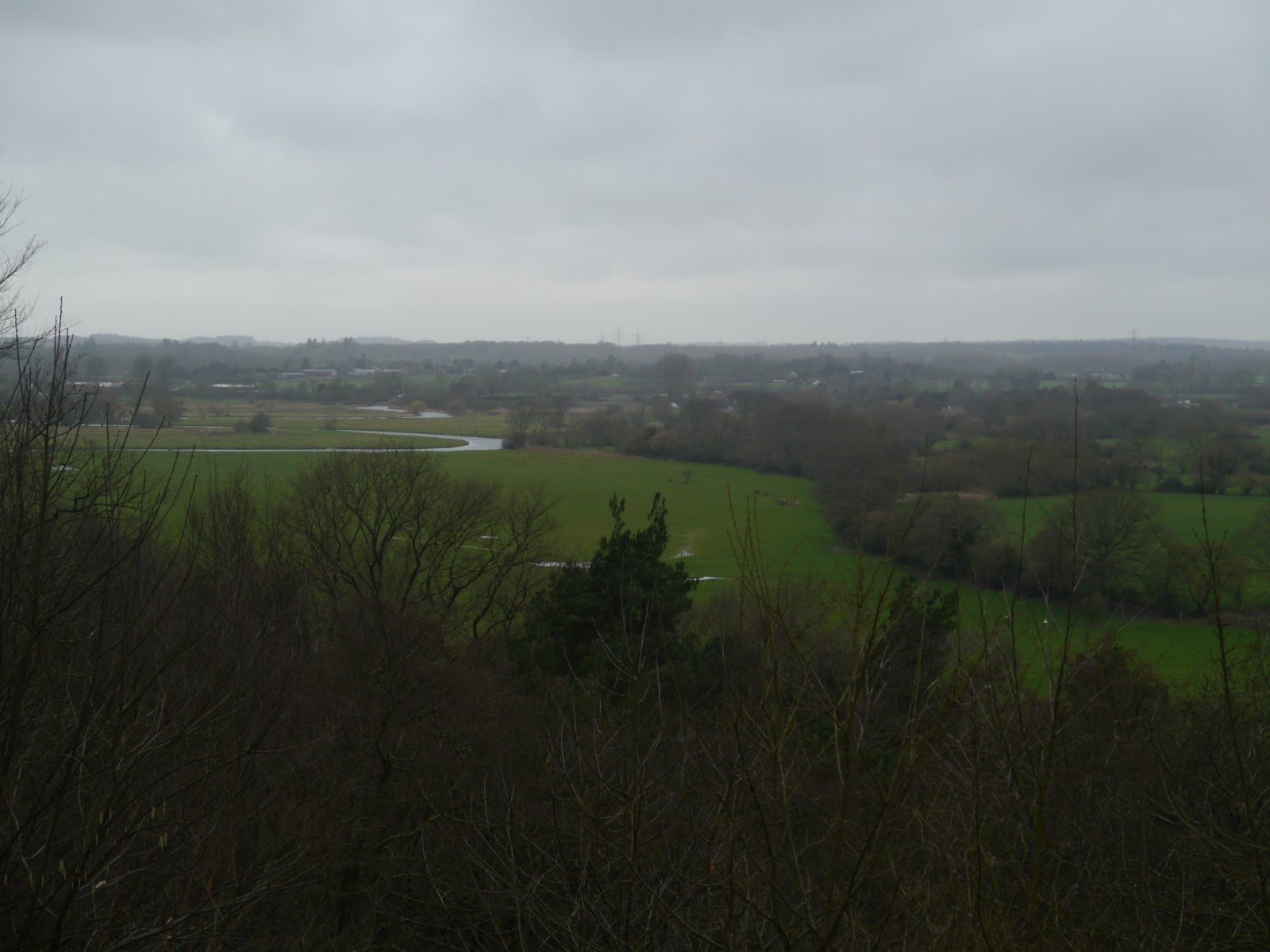
We had entered the New Forest National Park when we entered the meadows, but it didn't have the classic 'feel' of the Forest. Exiting the meadows via another farm, we headed across the cattle grid and into an area much more representative of the Forest. Ascending the hill, we passed many ponies in their thick, shaggy winter coast, merrily munching away on holly. This hardiness makes them excellent grazers throughout the year, and shapes the landscape in which they live. Deep in the enclosure of planted beeches are the remains of a castle. however, this is often overlooked because on the other side of the road (which is also the path at this point!) is a stunning view out across the floodplain. The flatness of the meadows contrasts with the hill on which you stand, and in the slight drizzle, the silver-snake of the river really stood out.


We continued our walk down through Woodgreen, picking up the old dismantled railway, now a footpath owned and managed by Hampshire County Council and also in an HLS agreement. We started at the well-preserved remains of the Breamore Railway station (which is now an office), walking back towards Burgate to the car. The routes runs parallel with the road, and cuts through more wet meadows, as well as areas of scrub and ponds, providing a linear corridor for wildlife.

An interesting route that brought back many memories - so glad the days of cross country are over!