Since becoming a Team Leader in June, I've not been out on site for work, which has come as a bit of shock to the system - I'm used to spending at least one or two days a week out in the countryside marvelling at some of the most scarce habitats and species in the country (and sometimes in Europe!).
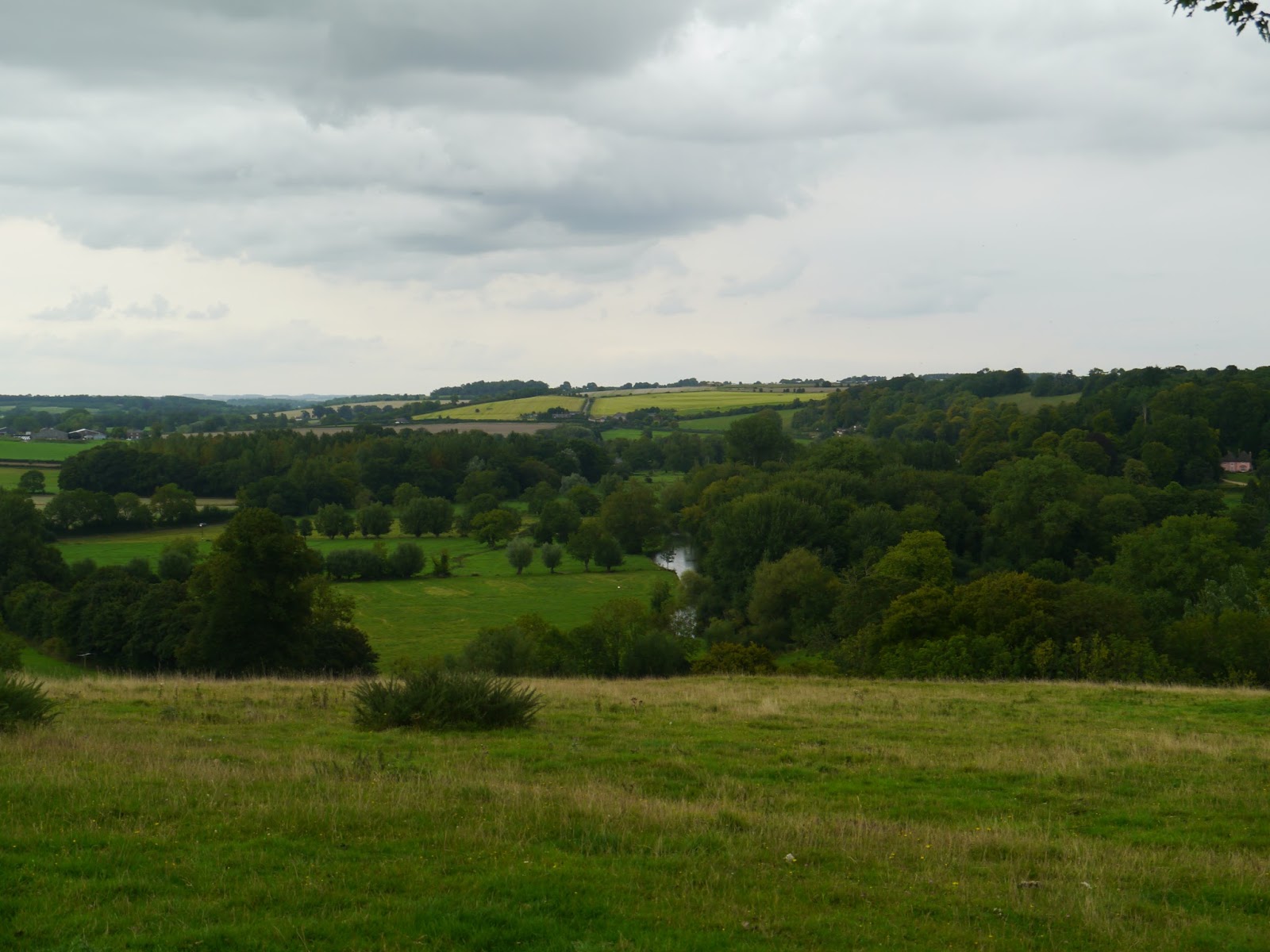
Finally, on Friday, I was able to get out and show colleagues how working with farmers and fishing clubs can reap great rewards, by visiting a farm on the upper reaches of the River Itchen, near New Alresford (north of Winchester).
The farmer is in an agri-environment scheme - paid for through EU (and a bit of UK Government) funds, encouraging farmers to farm for wildlife and protect the environment. This particular estate is large (about 1000 acres I think) and has the River Itchen Site of Special Scientific Interest (SSSI) and Special Area of conservation (SAC - internationally important) flowing through it. We've worked really closely with them to establish a suitable grazing regime with his wonderful Hereford cattle on the sensitive banks, and liaised with the fishing club to improve conditions for wild brown trout. Indeed, when we visited, there were several huge trout beneath one of the bridges - an indicator things were going OK!
The river is looking great on the whole - so inspiring to see after all that hard work, with the banks having a wealth of plants, connecting the river with the floodplain derelict watermeadows. The chalk stream was filled with aquatic plants ('macrophytes') including water parsnip and starwort - but none of the water crowfoot. Even this high up in the catchment, the water quality is not good enough to support it in places, a result of runoff from farms and other land uses (septic tanks for example).
But it was still great to see the site looking so beautiful - I hope to return invigorated to work on Monday (but also slightly more motivated to get things done as I'm off to Scotland for a week and a bit so no blog next couple of weekends I'm afraid).
Saturday, 12 September 2015
Saturday, 5 September 2015
A different Down
Last weekend I managed - in between an amazing baking spree and rain showers - to have a yomp up Camp Hill Down.
This is a piece of SSSI chalk grassland only 20 minutes' walk away from me - the journey there, however, is a tad on the dangerous side.
The Countryside and Rights of Way Act (CROW 2000) designated many patches of unimproved grassland and heathland as open access - meaning people could walk across it without sticking to any paths. Camp Hill is one such place - the trouble is, quite a lot of these don't actually link up with footpaths, so to get to them is a bit tricky. To get to Camp Hill, I have to walk a bit along the Avon Valley Path - fine so far. Then I come to a rather busy 60mph B road, with limited verge to walk along. I have to walk along this for about 10 minutes, BUT the reward is worth it - if you can find the bit of fence to climb over that isn't covered in barbed wire (I'm really selling this aren't I?!).
I quickly surprised a hare in the grass, as I walked up to the top of the downland, accompanied by a herd of sheep. At this time of year, the flowers are mostly over, but it is devils bit scabious season, so there were quite a few of these dark-purple flowers in among the grass and knapweed. There was also carline thistle - a strange flower in that it looks dried up when it is actually fresh and growing!
Turning around to look at the view, there is a stunning panorama over the river Avon and Woodford valley, with historic parkland estates and old houses and cottages - with views stretching all the way up to Salisbury Plain.
It's not a big site, so once you've admired the view and done a bit of botanising (lots of dwarf thistle!), it was time to once again take my life in my own hands and quickly walk back home. Such a shame there isn't a footpath!
This is a piece of SSSI chalk grassland only 20 minutes' walk away from me - the journey there, however, is a tad on the dangerous side.
The Countryside and Rights of Way Act (CROW 2000) designated many patches of unimproved grassland and heathland as open access - meaning people could walk across it without sticking to any paths. Camp Hill is one such place - the trouble is, quite a lot of these don't actually link up with footpaths, so to get to them is a bit tricky. To get to Camp Hill, I have to walk a bit along the Avon Valley Path - fine so far. Then I come to a rather busy 60mph B road, with limited verge to walk along. I have to walk along this for about 10 minutes, BUT the reward is worth it - if you can find the bit of fence to climb over that isn't covered in barbed wire (I'm really selling this aren't I?!).
I quickly surprised a hare in the grass, as I walked up to the top of the downland, accompanied by a herd of sheep. At this time of year, the flowers are mostly over, but it is devils bit scabious season, so there were quite a few of these dark-purple flowers in among the grass and knapweed. There was also carline thistle - a strange flower in that it looks dried up when it is actually fresh and growing!
Turning around to look at the view, there is a stunning panorama over the river Avon and Woodford valley, with historic parkland estates and old houses and cottages - with views stretching all the way up to Salisbury Plain.
It's not a big site, so once you've admired the view and done a bit of botanising (lots of dwarf thistle!), it was time to once again take my life in my own hands and quickly walk back home. Such a shame there isn't a footpath!
Saturday, 29 August 2015
Wild harvest
I love this time of year - as the evenings draw in, trees and hedgerows are beginning to be laden with fruit. I know it's still August (just about!), but it certainly feels very autumnal!
Last Sunday we started blackberrying, heading up to the drove by Salisbury racecourse, which forms part of the Wilton Estate. The humble bramble is actually a group of many closely-related species (called 'aggregates') that are nigh-on impossible to distinguish unless you're an expert botanist. It's funny how microclimate can play such a factor in ripening, and also the variety of blackberries present. In those sunnier spots, fruit was ripe for picking, but our haul was very low. The berries were also very tight and bristly, so not really suitable for eating straight away - I'm planning on making a big batch of blackberry jelly for Christmas presents (building on last year's blackberry chutney!).
Then after work on Thursday, travelling back from Dorchester, I pulled into Martin Down (of course!) for a quick foray over the road into Kitt's Grave. It's looking beautiful at the moment, with scrub clearance and grass cutting forming a rich mosaic of flower-rich glades and a variety of scrub heights. One glade in particular is wide enough to be mown with a tractor, creating a strangely-out-of-place striped lawn!
The hedgerows were laden - sloes, privet berries (not edible!), elder berries and of course blackberries. The latter were again not quite ripe, needing another few weeks, but in some sunny spots on the edge of glades there were some juicy ones. This variety has much bigger individual berries, so potentially better flavour - we shall see!
And the little carefully-cultivated bramble in my garden is now bearing a handful of fruit, and coupled with the rich bushes across the road on the way to the river, this year's blackberry jelly etc will have come from a wide variety of sources.
Last Sunday we started blackberrying, heading up to the drove by Salisbury racecourse, which forms part of the Wilton Estate. The humble bramble is actually a group of many closely-related species (called 'aggregates') that are nigh-on impossible to distinguish unless you're an expert botanist. It's funny how microclimate can play such a factor in ripening, and also the variety of blackberries present. In those sunnier spots, fruit was ripe for picking, but our haul was very low. The berries were also very tight and bristly, so not really suitable for eating straight away - I'm planning on making a big batch of blackberry jelly for Christmas presents (building on last year's blackberry chutney!).
Then after work on Thursday, travelling back from Dorchester, I pulled into Martin Down (of course!) for a quick foray over the road into Kitt's Grave. It's looking beautiful at the moment, with scrub clearance and grass cutting forming a rich mosaic of flower-rich glades and a variety of scrub heights. One glade in particular is wide enough to be mown with a tractor, creating a strangely-out-of-place striped lawn!
The hedgerows were laden - sloes, privet berries (not edible!), elder berries and of course blackberries. The latter were again not quite ripe, needing another few weeks, but in some sunny spots on the edge of glades there were some juicy ones. This variety has much bigger individual berries, so potentially better flavour - we shall see!
And the little carefully-cultivated bramble in my garden is now bearing a handful of fruit, and coupled with the rich bushes across the road on the way to the river, this year's blackberry jelly etc will have come from a wide variety of sources.
Saturday, 22 August 2015
Strange sounds
I swear I was woken up to the sound of a calling peregrine falcon the other morning - having heard the distinct call, closely followed by the aforementioned bird chasing a pigeon over our heads in Krakow, I recognised the sound. Bit odd for it to be calling in a quiet Salisbury suburb at 6am!
If it was a peregrine then it is further proof of this species' continued expansion and population recovery. They have moved into urban areas with much success, utilising the cliff-like walls of buildings for nesting sites, and catching other birds that pass through on their migrations, high above settlements. Indeed, analysis of prey remains in urban nests has turned up surprising revelations, including woodcock, not an urban species at all. It just goes to show an awful lot is happening above our heads when we're catching a few zs!
That evening was also the first that I heard my resident tawnies calling again - not the 'to-woo' but the high-pitched screechy 'twe-wit'. According to Wikipedia (!), now is the time of year when young disperse to find territories- so perhaps the resident pair are asserting their claim to this patch, or the young are trying it on!
This week also saw the culmination of this year's fruit and veg harvest - after a reasonable crop of garlic bulbs, and a very disappointing half a raspberry, my Victoria plum tree (planted nearly 3 years ago) has finally produced fruit. Although, as you will see from the picture, it was a very limited crop! It was very nice though - fingers crossed for more next year. My garden does, on the other hand, have a very rich invertebrate population, which has attacked all garden plants and fruit bushes/trees. I like to think I'm doing my bit for wildlife through my almost-impossible garden!
If it was a peregrine then it is further proof of this species' continued expansion and population recovery. They have moved into urban areas with much success, utilising the cliff-like walls of buildings for nesting sites, and catching other birds that pass through on their migrations, high above settlements. Indeed, analysis of prey remains in urban nests has turned up surprising revelations, including woodcock, not an urban species at all. It just goes to show an awful lot is happening above our heads when we're catching a few zs!
That evening was also the first that I heard my resident tawnies calling again - not the 'to-woo' but the high-pitched screechy 'twe-wit'. According to Wikipedia (!), now is the time of year when young disperse to find territories- so perhaps the resident pair are asserting their claim to this patch, or the young are trying it on!
This week also saw the culmination of this year's fruit and veg harvest - after a reasonable crop of garlic bulbs, and a very disappointing half a raspberry, my Victoria plum tree (planted nearly 3 years ago) has finally produced fruit. Although, as you will see from the picture, it was a very limited crop! It was very nice though - fingers crossed for more next year. My garden does, on the other hand, have a very rich invertebrate population, which has attacked all garden plants and fruit bushes/trees. I like to think I'm doing my bit for wildlife through my almost-impossible garden!
Saturday, 15 August 2015
Three butterflies of two species
That was the outcome of the Big Butterfly Count in my garden last Sunday, on the last day of Butterfly Conservation's 'citizen science' initiative. Not bad for 15 minutes on a cloudy and not-terribly-warm day. That was two large whites and a meadow brown, the latter spent the entire 15 minutes on one of my buddleias, thus demonstrating their value as a nectar source. In the sun, I have seen gatekeepers, small tortoiseshells and brimstones flitting by as well, so not bad for a little forgotten corner consisting of a near-vertical slope and a small patch of brambles (lovingly tended for this year's crop).
Later that day I headed out for the customary Sunday afternoon walk, back to Grovely Woods again. I've covered this part of the Wilton estate in previous posts, but it's a very handy local patch, with many permutations of loops to be walked. It's quite difficult to get lost (even for me!), as most of the forestry tracks in this mixed plantation woodland always come back to the main track 'First Broad Drive' through the wood. Lined with magnificent beeches, and stretching off into the distance, it makes for a very good yomp indeed! We took a side track off and found ourselves in a new area we hadn't been to before, along a path seemingly running parallel with the main drive, passing through a band of ancient woodland - a change from the dark depths of the conifers.
Tomorrow I'm hosting Sunday lunch, so the afternoon walk - if we can stir ourselves - will likely be off to Old Sarum again.
Later that day I headed out for the customary Sunday afternoon walk, back to Grovely Woods again. I've covered this part of the Wilton estate in previous posts, but it's a very handy local patch, with many permutations of loops to be walked. It's quite difficult to get lost (even for me!), as most of the forestry tracks in this mixed plantation woodland always come back to the main track 'First Broad Drive' through the wood. Lined with magnificent beeches, and stretching off into the distance, it makes for a very good yomp indeed! We took a side track off and found ourselves in a new area we hadn't been to before, along a path seemingly running parallel with the main drive, passing through a band of ancient woodland - a change from the dark depths of the conifers.
Tomorrow I'm hosting Sunday lunch, so the afternoon walk - if we can stir ourselves - will likely be off to Old Sarum again.
Friday, 7 August 2015
Work and play!
So one of the benefits of my role managing a team in Dorset is that this includes National Nature Reserve (NNR) staff, in particular, those that manage the Axmouth to Lyme Regis Undercliffs NNR.
For those of you unfamiliar (I was!), this is a stunning stretch of the Jurassic World Heritage Site coast from Axmouth to Lyme Regis (taking in the world-famous Monmouth Beach ammonite pavement). The undercliffs themselves are a series of constantly slipping blocks of clay. sand and chalk, creating amazing ravines, micro-habitats and rock formations, but making for dangerous walking. Indeed, one part of the south west coast path is still shut here. It's certainly an experience having a guided tour by the NNR staff, with the chosen route yesterday taking in a couple of ascents by short lengths of rope!
It has beautiful views of the coast and turquoise sea, with pockets of extremely diverse chalk grassland and moist fern-rich woodland.
The other end of the reserve at Lyme Regis plays host to the most accessible fossil-hunting stretch, including the ammonite pavement, where you walk on hundreds of these ancient fossils - quite spectacular. As a fossil hunter myself, this trip combined work and play! Last weekend it held the first ever fossilblitz (like a bioblitz but with fossils!) recording over a 1000 records - a great way to get the community and visitors involved.
For those of you unfamiliar (I was!), this is a stunning stretch of the Jurassic World Heritage Site coast from Axmouth to Lyme Regis (taking in the world-famous Monmouth Beach ammonite pavement). The undercliffs themselves are a series of constantly slipping blocks of clay. sand and chalk, creating amazing ravines, micro-habitats and rock formations, but making for dangerous walking. Indeed, one part of the south west coast path is still shut here. It's certainly an experience having a guided tour by the NNR staff, with the chosen route yesterday taking in a couple of ascents by short lengths of rope!
It has beautiful views of the coast and turquoise sea, with pockets of extremely diverse chalk grassland and moist fern-rich woodland.
The other end of the reserve at Lyme Regis plays host to the most accessible fossil-hunting stretch, including the ammonite pavement, where you walk on hundreds of these ancient fossils - quite spectacular. As a fossil hunter myself, this trip combined work and play! Last weekend it held the first ever fossilblitz (like a bioblitz but with fossils!) recording over a 1000 records - a great way to get the community and visitors involved.
Sunday, 2 August 2015
Walking away stress
This week was the first mentally-tough week in my new job, for a variety of rather boring reasons. And being cooped up in the office at Blandford (which, as you may recall, is on an industrial estate with nowhere to walk) on Monday and Wednesday had me crying out for a bit of the outdoors!
So after work on Wednesday I managed to squeeze in a short walk along Martin Down - one of the good things about my role, is that more frequent commuting to Dorset means I pass right by the NNR.
Perhaps I was just in the mood to enjoy being distracted by anything, but the rosebay willowherb - a very common ruderal plant - was present in stunning pink banks of colour along the Bokerley Dyke, contrasting against the warm ochres of the swaying upright brome grass. I had managed to pick a break in the rainstorms, but the ominous clouds made for a great background, and perhaps mirrored my mood when I started the walk!
Partway along, picking my way through knapweed and marjoram, providing an accompanying scent to my walk, I met one of the local farmers who was checking the sheep whilst the stockman was on holiday - always nice to chat to a like-minded person, out enjoying the countryside.
So, after a quick yomp of 30 minutes or so, I returned to the carpark somewhat refreshed, having mulled over and reflected on the week so far, and hopefully approaching the next day with renewed vigour.
So after work on Wednesday I managed to squeeze in a short walk along Martin Down - one of the good things about my role, is that more frequent commuting to Dorset means I pass right by the NNR.
Perhaps I was just in the mood to enjoy being distracted by anything, but the rosebay willowherb - a very common ruderal plant - was present in stunning pink banks of colour along the Bokerley Dyke, contrasting against the warm ochres of the swaying upright brome grass. I had managed to pick a break in the rainstorms, but the ominous clouds made for a great background, and perhaps mirrored my mood when I started the walk!
Partway along, picking my way through knapweed and marjoram, providing an accompanying scent to my walk, I met one of the local farmers who was checking the sheep whilst the stockman was on holiday - always nice to chat to a like-minded person, out enjoying the countryside.
So, after a quick yomp of 30 minutes or so, I returned to the carpark somewhat refreshed, having mulled over and reflected on the week so far, and hopefully approaching the next day with renewed vigour.
Subscribe to:
Posts (Atom)