Sunday, 2 April 2017

Rivers and wildflowers

Spring is really starting to hot up now - and quite literally! Last Sunday it was about 19 degrees - perfect for our post-Mothering Sunday meal walk along the Itchen Navigation.

Although busy, we were able to enjoy the beautiful river (actually a canal created for barging produce up from Southampton) and associated wildlife - the gnarly old trees overhanging the water were beautiful in particular. The banks were festooned with blackthorn blossom and celandines - gorgeous.

On Friday I called it a day from work early and headed up to Clarendon park - the ruins of the old hunting lodge were being weeded as I passed by, llamas looking on, and crossing into the ancient woodland. Here, I found toothwort (parasitic plant on hazel), primroses, wood anemone, dogs mercury and violets. All the while accompanied by skylarks, chiffchaffs, and a bullfinch. 

And I've just got back from a delightful day in the Test valley, walking parts of the Test Way and surrounding arable fields, including Harewood forest and it's beautiful ancient woodland flowers. I love this time of year - bluebells were just starting to come up so I'm hoping for a brilliant spectacle in a couple of weeks' time.


Sunday, 26 March 2017

Spring sunshine

Haven't the last few days been beautiful? I've tried to make the most of it!

Last Sunday I met a friend on Martin Down - it was blowy and overcast, but hearing the skylarks, yellowhammers and a bullfinch, together with spotting the hairy violets flowering, made for a beautifully atmospheric walk. Spring is certainly here.

And this week I've managed a few evenings of walks from the flat along the Avon Valley Path - the benefit of the longer days. All the trees are in bud and the bushes are bursting into leaf with that vibrant green characteristic of this time of year. The low evening sun casts spectacular shadows and backlights delicate natural forms of reeds and brambles - common species whose beauty is often overlooked.

Let's hope this weather continues for a bit, but of course, it is England...


Saturday, 18 March 2017

Free!

Last weekend I had my uni housemates and husbands over, and decided to show them the ultimate free way to see Stonehenge!

Apparently, the extortionate cost of paying to see the stones up close and enter the visitor centre (which I am told is excellent) is to offset other English heritage properties/sites that make a massive loss due to restoration costs. Nonetheless, this walk takes you through the historic landscape with excellent interpretation along the way.

We started at the Woodhenge carpark - here you get an excellent view of the scale of Durrington Walls - a large circular banked enclosure - and the not-so-impressive Woodhenge. This is basically a set of post holes filled with short pillars of concrete to give an impression of their positioning. In reality, they reckon the wooden posts would have been several metres tall.

Moving on, we crossed a meadow filled with singing skylarks above us, and moved onto the dismantled railway. The route then took us behind the posh officers' houses at the barracks before the Cursus came into view.

This point is marked with an information board, marking the astonishing scale of the earthwork - the end of it can't be seen from this position. It was probably a banked enclosure for ceremonial purposes but we can't be sure - part of the mystery of the place. We crossed the Cursus and several more fields, all with skylarks and sheep, being under the management of the National Trust. We could see the stones in the distance, but the undulations of the land meant it came and went from view several times. No doubt, this was planned to add to the mystery. Arriving at the stones via the Avenue processional route, we were able to get great views without paying a penny! This is thanks to the closure of the old A344, now restored to grass to reconnect the landscape. We returned via some cordoned off (to allow grass to recover) bowl barrows and crossed the Cursus (although we only realised it when we looked to the horizon!) before heading back the way we had come. In the summer, the meadows are full of wildflowers and a range of invertebrates too.


The next day we walked into Salisbury centre via the Avon Valley path - something I had not yet done despite living in the area for 5 years! The start is the usual route either to Old Sarum or to the Stratford Reserve (which was looking very sad having had no management for yet another year), but we carried on along the extensive boardwalk and then into Salisbury itself. A kingfisher was spotted and the first chiffchaffs of the year were practicing their songs. It was a surprisingly easy walk, and didn't take us that long to get into town - something I'll definitely do more of in the future.


Saturday, 4 March 2017

Old Ground

Last Sunday we were wracking our brains for somewhere to walk that wasn't going to be too muddy (after all that rain), which was relatively sheltered (due to the wind!) and somewhere a bit different. I thought a potter along the Avon Valley might be interesting, starting off on very familiar ground!

We parked up just off the A338 outside what used to be The Hourglass restaurant (now an Indian), right next to my old school 'The Burgate'. The start of our route really got the memories firing up - it was our cross country course. It started off through a farmyard (following the Avon Valley Path) and out onto watermeadows. Back in my day, the farm was a dairy - consequently, the yard was absolutely disgusting. I remember carefully picking my way through the excrement, only for fellow runners to come full-pelt through and splash me - ugh! Nowadays, the farmer has closed his dairy and diversified - holiday cottages, willows for cricket bats and beef cattle. Several years ago I tried to persuade him to come into a Higher Level Stewardship (HLS) scheme - although I wasn't successful at the time, clearly he needed more time to think it through and did eventually come into the scheme, safeguarding this area for wildlife.

Once through the yard and crossing the meadows, you start to see a ridge ahead of you as the gravel terraces making up this massive floodplain come into view. Here, the river is wide and meandering, providing ample habitat for a variety of wildfowl, although when we visited there were only swans! there were, however, also no people!

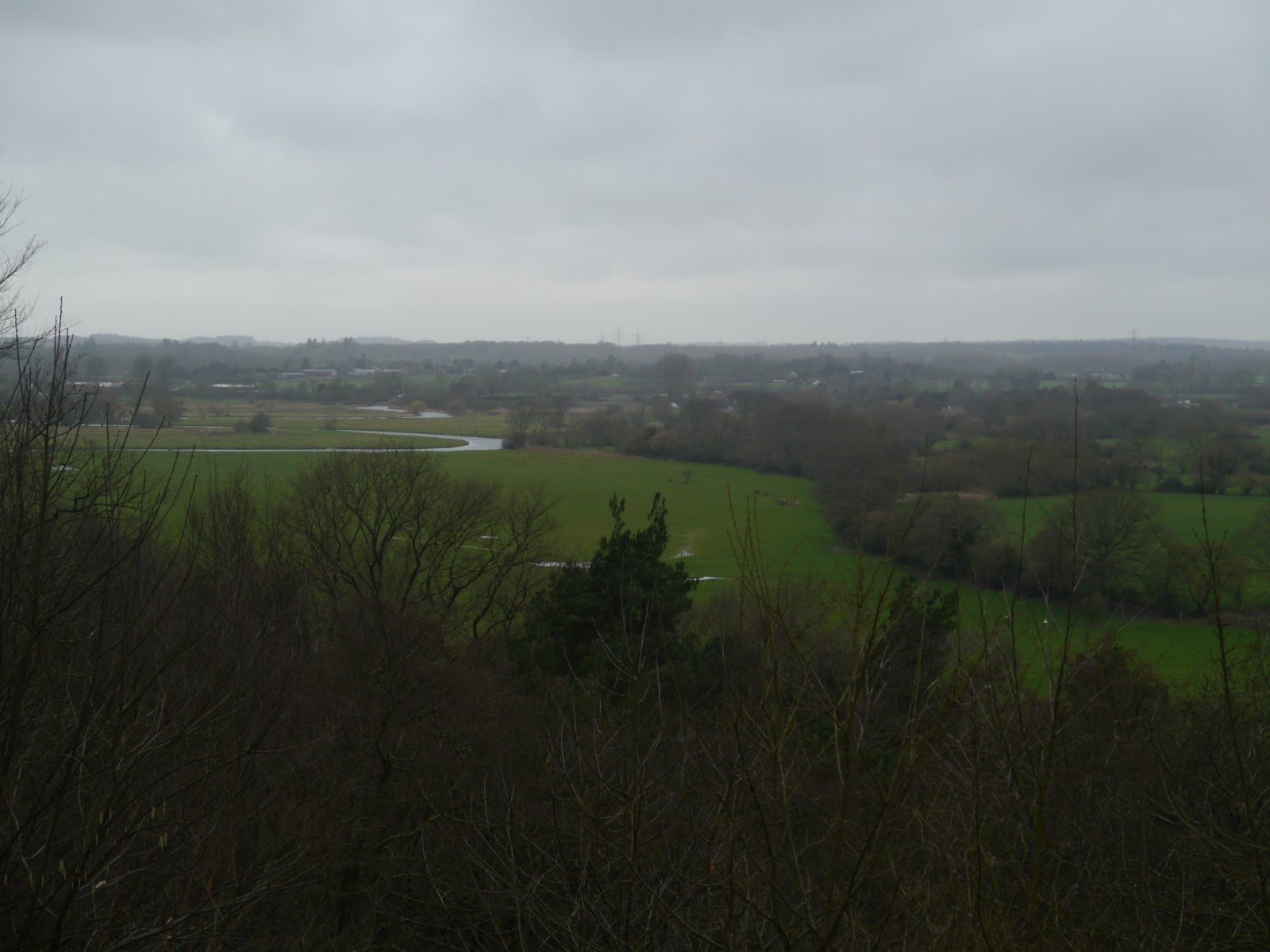
We had entered the New Forest National Park when we entered the meadows, but it didn't have the classic 'feel' of the Forest. Exiting the meadows via another farm, we headed across the cattle grid and into an area much more representative of the Forest. Ascending the hill, we passed many ponies in their thick, shaggy winter coast, merrily munching away on holly. This hardiness makes them excellent grazers throughout the year, and shapes the landscape in which they live. Deep in the enclosure of planted beeches are the remains of a castle. however, this is often overlooked because on the other side of the road (which is also the path at this point!) is a stunning view out across the floodplain. The flatness of the meadows contrasts with the hill on which you stand, and in the slight drizzle, the silver-snake of the river really stood out.


We continued our walk down through Woodgreen, picking up the old dismantled railway, now a footpath owned and managed by Hampshire County Council and also in an HLS agreement. We started at the well-preserved remains of the Breamore Railway station (which is now an office), walking back towards Burgate to the car. The routes runs parallel with the road, and cuts through more wet meadows, as well as areas of scrub and ponds, providing a linear corridor for wildlife.

An interesting route that brought back many memories - so glad the days of cross country are over!


Thursday, 23 February 2017

'I expect a view'

A view is a key requirement for a walk, particularly one in winter when wildlife isn't doing much. Luckily, I have many such places around me!

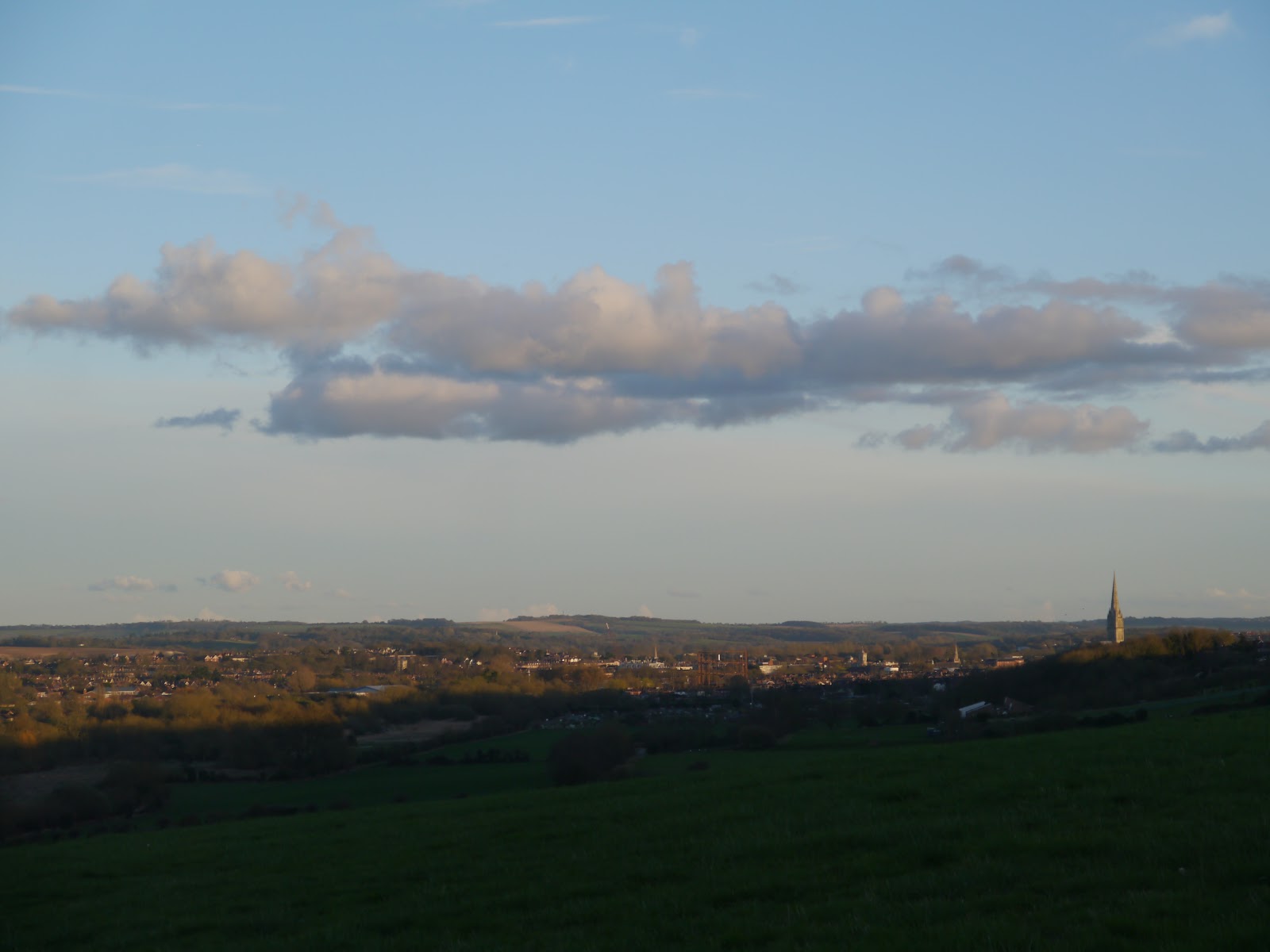
Last Sunday we opted for a visit to Pepperbox Hill, just south of Alderbury off the A36. The Pepperbox itself - a folly built in 1606 - is well preserved and set amidst chalk grassland and scrub. If you want along the chalk ridge, following the ancient Ox Drove, you are rewarded with sweeping views across to Salisbury, Cranborne Chase and Bentley Wood. It is hard to do a loop though - it's a bit of a 'there and back' walk - and it can get very muddy!

During the week I've had a few spare moments to get some exercise in my lunchbreak, featuring walks along the Nun's Walk Stream in Winchester. A small chalk stream tributary of the Itchen, it's had a lot of restoration work done over the years, and runs along an ancient footpath, with associated old buildings and ruins. On my walks, I saw a large area of frogspawn, and watched a little egret and pair of grey wagtails feeding. All within a stone's throw of the city centre.

I'm just back from braving a walk in Storm Doris on a day off work. I'd elected to walk around Langford Lakes Nature Reserve and then climb onto the surrounding hills, but when I got there, the Wiltshire Wildlife Trust-owned reserve was closed due to high winds! I had to rapidly find an alternative route and parking place. Instead, I parked on a nearby verge (tut tut) and walked through the opposite Langford Trust-owned bit of meadow and river towards the footpath by the church. Lots of snowdrops! I then began my climb up another Ox Drove, picking my way over falling trees and branches and keeping a constant eye on the swaying trees above me! Eventually, with no cover at all higher up on the hill, I was forced to descend due to not really being able to stand up! Still, the constantly changing weather conditions made for lovely light on the landscape - most excellent views!


Saturday, 18 February 2017

Combining pleasures

As well as loving walking, I also love painting and drawing. And with a teleconference cancelled on Thursday, I had the opportunity to take the afternoon off and head up to (where else?) Martin Down for a spot of sketching.

It was a lovely sunny afternoon, and quite mild - Spring is in the air! I decided to head across the reserve, up to Pentridge Down. Rising above Martin Down, you are rewarded for your climb with stunning views across the reserve and beyond to surrounding villages and the sweeping landscape of Cranborne Chase. I didn't quite make it to the top of Penbury Knoll (a hill fort and 185m high) as I wanted to have some time sketching - there is an amazing rusty old harrow (for raking the fields) that forms a brilliant foreground.


The return trip was very muddy, but I really hate walks where you retrace your steps - better to have a muddy circular route! Arriving back at the carpark, and with very little wildlife spotted en route, I heard my first yellow hammer of the year, warming up for the busy few weeks ahead. I can't wait for everywhere to burst into life.

Monday, 13 February 2017

Growths

It's been a very contrasting few weeks, what with my trip to snowy climes, and then the pathetic attempts at snow here!

I had been skiing on the Italian/French border, which had featured lots of snow (unlike last year's heatwave!). I always love the journey on a chairlift - taking your mind of loss of feeling in increasingly-numb extremities through trying to identify the wild animal tracks. Evidently, lots of mountain hares and foxes present - a sign of a healthy ecosystem.

One day there was a complete deluge of snow, where we opted to go for a walk along one of the mountain paths. I love the way the snow coats pretty much every surface, including seemingly vertical tree trunks. One tree we stopped by, though, had the most amazing lichens attached to it. Amazing forms and colours - easily overlooked.

And indeed, this was also the remark we made on yesterday's walk in Bentley Wood. Not much to see at this time of year, apart from the sudden growth of fungus on the timber stacks, forming apricot-hued frilly rings around cut trunks.

There were many signs closing paths due to 'wildlife management' - with the tell-tale illustration of a stag. In fact, we saw several herds of fallow deer. In high numbers, their browsing prevents the regrowth of sensitive woodland plants. Without the wolf to control them, it's down to us instead!