Saturday, 25 August 2018

Ups and downs

It's been another mixed week weather-wise, but in between the showers, I have been able to continue my explorations!

Last Saturday was a bit of a murky day, but perfect weather for walking. We started at Burgate Manor Farm, retracing my old school cross country route along the Avon Valley Path. This old diary farm has now diversified into holiday lets and less-intensive grazing, ensuring walkers no longer have to wade through slurry in the farmyard.

Almost immediately, you come upon the only suspension bridge in Hampshire, apparently built from an old military Bailey bridge, crossing a channel of the Avon as we make our way across the wide, flat floodplain.

Now extensively grazed by cattle, this vast plain was once irrigated watermeadow, with water levels carefully managed to enable early grass growth for livestock. It's now a haven for wildlife, especially in the winter, with flocks of wading birds descending on the wetlands, making it internationally important for several species, and thus legally protected.

Our route continued out the other side of the floodplain, and up a terrace into the New Forest, with amazing views over the wide sweeping meander of the river. We continued on our own meandering route, through small meadows and patches of ancient woodland, coming out at Frankenbury Iron Age hill fort, skirting part of the hilariously-named Sandy Balls holiday park. We then looped back and retraced our steps through the farmyard.


The following day, with the sun shining, and after a lovely pub lunch with friends, we headed up to the Cherhill White Horse north of Devizes. This is apparently the third oldest in Britain, dating from the late 18th century. Right next to it, on the high ridge, is the Lansdowne Monument, apparently built just to catch the eye in 1845, and currently cordoned off while funds are raised to restore it. The views down across the flat land north of Calne are stunning, with the grassland itself a haven for chalk downland species so typical of Wiltshire. Indeed, on our walk up, we spied numerous butterflies including speckled wood (in the shady hedgerow-lined path) and a possible Adonis blue.


And finally, taking a cheeky day off mid-week, I went on a long-ish loop at Grovely Wood, near Wilton. distracted by blackberries (lots - Autumn is coming!) we eventually found our way back onto the main avenue, spying interesting clumps of fungi along the way.


I feel like I've seen the last vestiges of Summer with the very beginnings of Autumn.

Wednesday, 15 August 2018

Think that was summer...

Yes, it definitely feels like the nights are drawing in and autumn is imminent. The blackberries are nearly ready, the plums on my tree are ripening, and I'm starting to get some raspberries too.

But, on the wildlife side, there's still a lot of summer going on out there. From my quick walks after work down to the river - accompanied by the second brood of speckled wood butterflies flitting along the tree-lined path - to the flowering buddleia attracting tonnes of butterflies in my garden.

And when we walked into town in the drizzle on Saturday, the riverbank was looking beautiful - a mosaic of purple loosestrife and fleabane, proving that nature completely gets the colour wheel (purple and yellow are on opposite sides - a perfect compliment).

However, what with the patchy drizzle, wind, and very-active butterflies, not any pictures I'm afraid.

But on Sunday we braved the weather - and the tourist hordes - and pottered around Bath for the day. One way of avoiding the crowds was to walk through the lovely botanic gardens - the residents of Bath are very lucky to have this enormous greenspace on their doorstep. the highlight of our walk around here was actually the leopard slug hiding in one of the monuments in the park. This large slug is known to pursue other slugs for dinner at the top speed of 15cm a minute (thanks Wikipedia), and mates suspended on a mucus string. I bet you'll all be looking for leopard slugs now!

Wednesday, 8 August 2018

Come rain come shine

Of course, it's mostly been 'shine' for the last few weeks, but even when we had that hideous weekend a couple of weeks ago, we still ventured out!

Actually, when we arrived in Mudeford near Christchurch, it wasn't too bad - very windy but only occasional rain. It did mean the Mudeford Arts Festival was much reduced in size, but after a quick amble along the quay and pub lunch, we decided to brave the conditions for a walk. The waves were quite spectacular - lots of windsurfers out in force - as we walked along the beach, passing the colourful beach huts.

Part of this coast is legally protected as a SSSI, primarily for its geology and erosional processes - lots of slumping clays, sands and gravels, which also make excellent habitat for reptiles and insects. Not that they were evident that day!


This weekend was a different story - baking heat as we walked across St Catherine's Hill into Winchester and back via the Itchen Navigation. Despite the sun-baked ground, there were still enough flowers (knapweed, small scabious, wild carrot etc) to tempt the butterflies down for a sip of nectar. So many fighting chalkhill blues, tussling in the air and making it nearly impossible to photograph their beauty!


And I've just got back from a short foray around Laverstock Down on the outskirts of Salisbury. Again, very sun-baked, but still some flowers present - birds foot trefoil, dwarf thistle, wild carrot, ladies bedstraw, knapweed. Unfortunately the windy conditions rather kept the butterflies at bay, but it was still great to see the vivid patches of colour and the various exquisite flower forms. And lots of sloes on the way too!


The weather looks to be taking a turn for the worse again, but don't we need it?!

Wednesday, 25 July 2018

Catching up

Where has the time gone? Well, despite the radio silence, I have been very busy: Salisbury Art Trail,  holiday in Corfu, and enjoying the heatwave!

I have managed to fit in a few walks but only now have the time to write the blog. I've been pottering in the Test Valley by Chilbolton Common, seeking inspiration for my next painting.


I finally made it to Martin Down - it had been ages since I'd last been - but alas the weather has scorched most of the flowers, so it was all a bit brown. The views were still amazing, as we extended the walk up to Pentridge Down and down the other side to the Roman Road in a big loop in the boiling sunshine - perhaps a bit ambitious for the heat of the day! It did guarantee peace and solitude however!


Last weekend we decided to head to Selborne - home to Gilbert White, the 18th century naturalist famed for writing one of the first detailed accounts of wildlife 'the natural history of Selborne'. It is a very pretty village and, with most people being at the beach on another hot day, we had it and the adjacent Selborne Common to ourselves. This part of north-east Hampshire is famed for its hanger woodlands - steep beech and ash woodlands. In fact, it was here that I had a taste of my first woodland survey in 2006 - rather precipitous! The views from the Zig-zag path cut by Gilbert and his brother hundreds of years ago back down to the village and way beyond are stunning, especially on the glorious sunny day when we went. Ambling through parts of the woodland, the recently-cleared glades and small pockets of hay meadows were home to many butterflies, including silver-washed fritillaries. The males perform a looping dance around the female, brushing her antennae with his pheromone-coasted wing hairs - quite a spectacle, and one that is becoming rarer as sunny glades in mature woodland decrease.


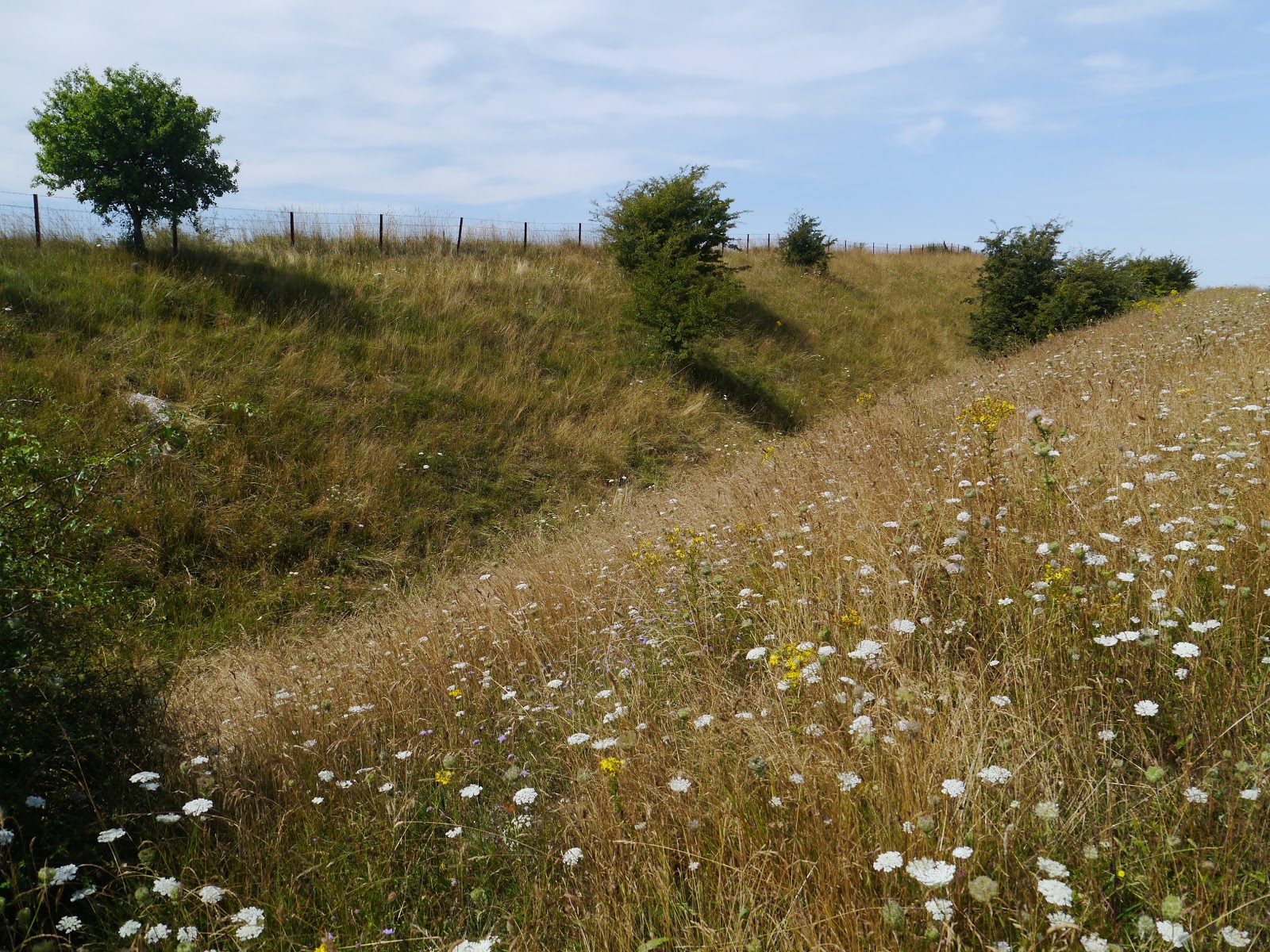
And then today - on my way back from collecting a box of neolithic arrow heads bequeathed to me by a friend, I called in at Morgan's Hill Nature Reserve. This is a small chalk downland reserve perched high on the hills above Calne, north of Devizes and owned by Wiltshire Wildlife Trust. I looped up and around, abuzz with butterflies and other insects feeding on the fading flowers of knapweed and scabious. Part of my route took me along the Wansdyke - named after Woden and possibly post-Roman/early Anglo-Saxon, and still very obvious in the landscape, with steep banks. These banks were alive with flowers and butterflies, and accompanied by amazing views across the Wiltshire downs. I even spotted several clumps of the rare round-headed rampion, a real chalk-downland specialist.


So, despite the heatwave, wildlife appears to be thriving.


Thursday, 7 June 2018

Badges and buzzes

Despite the busy lead-up to the Art Trail - with all the preparation it brings - I have managed to sneak in a few nice walks in the sunshine.

Bank Holiday Monday = pub lunch surely? And what better way to justify this than to walk there and back. well, almost. We decided to park in the layby by the Fovant Badges viewpoint out west of Salisbury, and head over to Broadchalke. A lovely loop we've done many times before, but always worth doing again! The Badges - as you may recall - are regimental badges cut into the steep chalk escarpment overlooking the village of Fovant. They're best viewed from afar, but the walk takes you right passed them, whereupon they take on a more abstract quality.


Signs of a past spectacle of cowslips, the singing of corn bunting, yellowhammer and skylark, and spectacular views down to the valley below, made our steep ascent worthwhile. We then looped down through various chalk valleys towards Broadchalke for a delicious lunch in the sun. The route back took us along an old droveway, with more beautiful views, including a red kite swooping over the treetops. the latter has become a much more common sight around Salisbury now, which is great to see in these days of doom and gloom. The final descent took us along an ancient trackway, cutting across the steep escarpment, lined with clumps of horseshoe vetch, with yet more skylarks. Stunning.

Then, last Sunday, we decided to head to the New Forest. At this time of year, careful planning is required. A sunny day in the forest is attractive - so the hordes often descend. Starting from a less-touristy spot - the Canadian Memorial - we walked down to Burley along the cycle paths. Although easy, it seemed long in the heat of the sun. It passed through tranquil ancient woodland and conifer plantation, with the hot sap creating a summer scent reminding me of childhood holidays in the South of France. dense stands of tall foxgloves lined the way, with trees humming with life - notably a deep buzz of a hornet, which we watched for a while at a distance. Detouring away from the cycle paths and the road on the final approach to Burley, where a cold drink awaited, we crossed a beautiful wildflower meadow, with good clumps of common spotted orchids and spearwort, before lunching in a lovely patch of woodland sat on a fallen tree.


Quenching our thirst in the village, we took a slightly different route back, which we more than slightly regretted due to a seemingly-impassable bog dotted with dead trees with unstable branches to cling onto. None of the party were lost! Taking a beautiful woodland ride over a lovely stream, where we watched beautiful demoiselles dancing in the sunlight, showing off the male's iridescent turquoise wings, we rejoined the cycle path back to the car. A long but beautiful walk avoiding most of the crowds.

Sunday, 27 May 2018

Calling on cue

I was just wondering when I might hear a cuckoo - it is May after all - and lo, walking up to Old Sarum the other day, I heard my first one. I wonder whether it is the same one (they do live for several years) as I always seem to hear one down there. After that, I just kept hearing them.

Last weekend saw me finally get to two of my favourite haunts, albeit late for some floristic spectacles. First up was Garston Wood - the bluebell wood of choice every year, near Sixpenny Handley south-west of Salisbury. Although the bluebells were sadly over, other woodland species were taking their moment to shine. Orchids - the strange green flowers of twayblade, the beautiful deep magenta of early purple, and one small spike of a common spotted. Together with the delicate tufts of sanicle, and the intriguing yellow hooded towers of yellow archangel, as well as some patches of ramsons still trying to make a show, it was a bit of a botanist's dream! Our route took us out of the RSPB reserve into neighbouring fields, where we had a great view of a male cuckoo flying across in the distance, together with the calls of skylarks and yellowhammer. We also had views of a pair of buzzards, including one sat in a tree staring at us from afar.

Next up was Martin Down (of course), where I had hoped to catch some of the cowslips - they were, sadly, a bit past their best, but still showing enough in numbers to enjoy. I couldn't see any burnt-tip orchids (possibly too late) nor adonis blue butterflies (possibly too early!), but the short turf next to the enormous Bokerley Dyke earthwork contained lots of chalk milkwort (deep indigo and white morphs), with patches of the striking kidney vetch. In the distance, calls of the rare corn bunting, lots of skylarks and yellowhammers. But the most beautiful - and reassuring - was the calling turtle dove from the hedge next to the main car park! We heard several on our travels. These beautiful doves face a very difficult life and journey, with populations having declined alarmingly. They overwinter in sub-Saharan Africa, facing food shortages and lack of habitat. Their migration across the Mediterranean is littered with hunters poised atop hills trying to shoot them out of the sky. And then when - if - they finally make it, they face similar food and habitats shortages over here, due to intensification of agriculture. Martin Down is a bit of a haven though - you can always hear them. This persecution also afflicts the cuckoo, with numbers declining. It may be sad to face a British countryside without the calls of quintessential birds such as the skylark, turtle dove and cuckoo.


Finally, today we popped up to the delightful village of Tisbury, just west of Salisbury, for a quick walk up and around the lovely countryside here, and a visit to the wonderful Messums art gallery. Our route crossed the Nadder, in a beautiful spot with clear water and water crowfoot flowering. We then headed up the valley sides for great views over the village, accompanied again by yellowhammers and skylarks, before reaching our end point of Fonthill lake. This is part of the large Fonthill estate, with 'grottoes' created along one side, although not publically accessible.


With the Salisbury Art Trail about to kick off (2nd - 17th June) I'll be busy each weekend demonstrating my painting at Henderson's Bakery in the Market Square, so less opportunity for walks and therefore blog posts. Hope I don't miss any more natural spectacles!