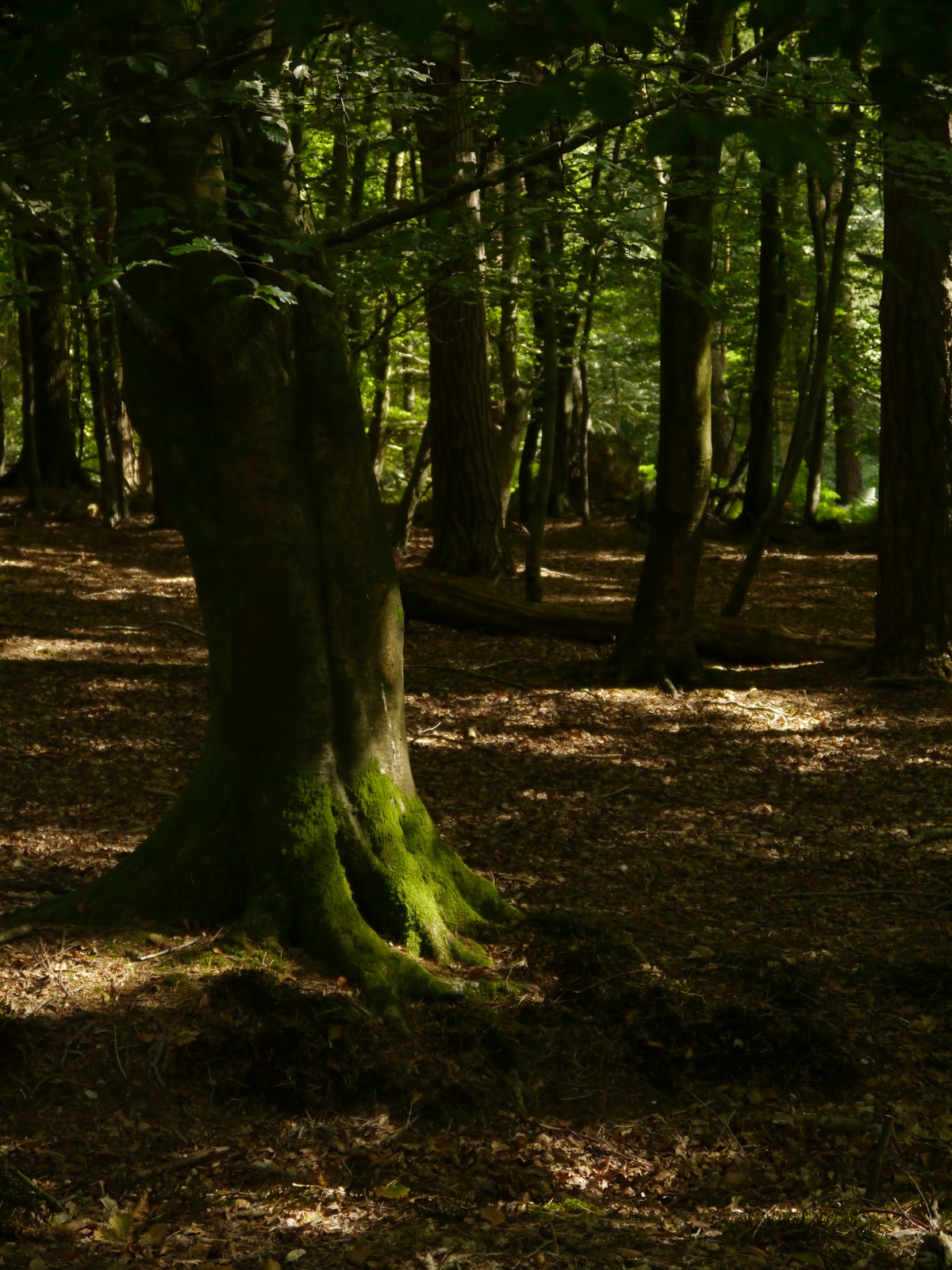
I suppose we've been lucky - the end of 2018, and the beginning of 2019, have both been dry but murky. Days have seemed shorter than the season predicts. Nevertheless, we've made the most of the freedom from work and enjoyed a fair few forays, to keep the mince-pie-calories at bay!
It's been a while since I've been up the hill behind my parents' house in Harnham on the outskirts of Salisbury. Sadly, this area of farmland is now to be turned into houses - where will the skylarks and yellowhammers go? It's the trouble when they're not legally protected species and yet they are declining rapidly through loss of habitat. The Chalkpit (a geological SSSI) and Harnham Slope (County Wildlife Site) will both remain, so walkers and some wildlife can continue to enjoy, but alas, not the farmland birds for the habitat is very different.
I also managed a quick walk on Martin Down - as I'm moving to Winchester in the spring, I'm not sure how often I can get back there, so I will miss it dearly. Not much wildlife to speak of - it's like the gloomy weather has them all hunkered down - but the views are always amazing.
We then had a day in the New Forest, visiting the Setley area for two shortish walks, punctuated by a lovely roast lunch at the Vineyard tea rooms. Although the first walk was rather mundane - the usual flat, open heathland, not exactly at its best this time of year - the second walk was a bit longer and looped through woodland along cycle paths, returning to the car parked at Tilery car park by balmer Lawn. The lawns of the New Forest are a bit of a speciality - some might say they are over-grazed, but in fact the short turf provides ideal habitat for a whole host of diminutive plants.
Another day of walking, starting at Langford Lakes Nature Reserve for a spot of birding - lots to see, including wigeon, tufted ducks, little egret, a possible snipe, cormorants, teal, gadwall and a possible shelduck. The afternoon saw us yomp along to Stone Henge on one of our favourite archaeological walks, returning in the deepening gloom!
Then New Year's day dawned, and we arose in sufficient time to head off to Lulworth Cove. It was rather busy when we arrived at 11am, and got busier throughout the day. Some of the coastal path is through military ranges, which are only opened at certain times of the year, New year's Day being one of them. Not that the crowds were there - it was a lovely sunny day, albeit a bit blustery, and most had headed to the Durdle Door beach for a picnic lunch. We could see why - it's a beautiful spot, and worth the slog up the hill to get there. If you haven't been to see the amazing rock formations, you're missing a trick.
We, on the other hand, walked back to Lulworth for a spot of lunch in the pub, before heading the other way along the coastal path. This part was very quiet and tranquil, and the views of Mupe and Worbarrow Bays, as far as Kimmeridge, were stunning. We retraced our steps back to the cove itself, where we had walked along the beach and climbed steps to the coastal path. This time we opted to head overland, which may have been a mistake, as we ascended many very steep steps to the top of the ridge. The path then took us behind the cove, as the sun was setting behind distant views of the Isle of Portland, then diverted inland, away from the carpark we could see below us. We did find a path back, but it was boarded up, prompting a climb, as there were no signs to say the path was officially shut. Phew - back in time to be able to make out the car in the gloom!
I wonder what other walking adventures 2019 will hold, and will try to keep packing them in - aren't we lucky?
Saturday, 5 January 2019
Saturday, 29 December 2018
Wigeon-tastic
Braving the predicted weather, we decided 2018 needed one last visit to one of our favourite places, the Lymington and Keyhaven marshes on the New Forest coast.
Our plan was to park near the Gun Inn (home of excellent crab sandwiches) and walk to the Chequers Inn (excellent pub- untested Sunday roast!). With some heavy rain the previous few days and nights, it was all rather soggy on the marshes themselves, but the great thing about this walk is that you mostly stick to gravel paths along the sea wall. This also gives you great views of many bird species, relaxed in your presence knowing you can't get to them.
We'd barely started our walk when we saw our first dark-bellied brent geese, having arrived from their breeding grounds of Siberia. The south coast is internationally-important for wintering populations of this goose. The pale-bellied favours Ireland, breeding in Greenland and Canada. It's quite amazing to think that right next to the busy ports on the south coast, we have such an important population.
Moving on, with murky views of the Isle of Wight on our right, the ponds and pools on our left behind the sea wall were filled with many species of bird. Along the way to the pub, we saw shelduck, tufted duck, shoveler, pochard, lots of pintail (which originally stumped us as we couldn't see the long 'pin' and they were head on, hunkered down from the wind), little egret, wigeon, redshank, and we heard lots of curlew and oyster catchers on the marshes too. We diverted inland to the pub, stopping for amazing views of wigeon feeding undisturbed by our presence only a few feet away. They are very smart ducks, and have a lovely wheezy-whistle of a call. I'd never seen so many wigeon in one place before.
After a delicious roast, we exited the pub, to find it had just started drizzling. We'd been lucky with the morning's weather, but alas, it had caught up on us. Our plan was to walk a longer route back along the sea wall, but as we reached the wall, the wind picked up, as did the rain. We did get some great views of lapwing, but shortly afterwards, decided to cut our losses and divert inland for a more sheltered and shorter route. The heavens really opened in the last few minutes, but overhead, as if to take our minds off the drenching, several large flocks of brent geese flew overhead in loose V-formations - stunning!
A great end to a lovely if saturating walk - we know we'll be back several times in 2019!
Monday, 3 December 2018
Long shadows
On a sunny winter's day, the beautiful golden light cast low from the sky picks out features in the landscape, casting wonderful long shadows. As the winter storms move in, these days are to be treasured.
Last weekend was fairly monumental in that our Sunday walk features a free roast lunch! Long story but it was all a matter of timing for when the pub had reopened the kitchen after 6 months. Our walk from Upham to Owslebury in the South Downs National Park took us down ancient trackways and droves, carpeted with the fallen autumnal russet of beech and the yellow of field maple. Small coral-pink blobs ensured we looked up to see the spindle fruits above our heads. All of these together signify an ancient hedgerow (well, unless recently planted!), walking in the footsteps of our ancestors. If only the track could talk!
And then onto this weekend, which not only featured the customary post-lunch walk to Old Sarum with my parents, but a quick pre-lunch foray around the Woodford Valley, admiring the thatched properties and beautiful River Avon. We startled a little egret, it's bright white plumage almost shining among the bare, drab branches following the latest storm. No long shadows there!
Saturday, 17 November 2018
Birding contrasts
Apologies once again for delays in posting - what with an amazing trip to India and catching up on things since getting back, it's been a bit busy!
I've not had too much time to get outside in good old Blighty recently, but one visit to Langford Lakes Reserve (just north of Salisbury on the A36) made me compare with the extraordinary wildlife I'd seen in India.
Although the primary goal was to see tigers (6 tigers and many, many photos later..), the birdlife was quite incredible. The bird list has not yet been totted up, but certainly over 70 species were seen. However, it wasn't so much the diversity, but the behaviour of several species that really got me thinking. In particular, the treepie - an extremely common corvid (crow), with the usual inquisitive nature you associate with that family. They are also extremely beautiful. It draws the inevitable comparison to our own magpie. How many of us stop and watch them and admire their gorgeous colours? It's interesting that a trip to faraway lands has made me stop and look at our commonest species back home.
And so it was at Langford Lakes - we took great delight in watching the various species of duck there. OK, it's not a tiger, but once you spend time watching something, you almost feel a part of its world. The lakes are known for their overwintering wildfowl, and now is the time for them to gather. We saw lots of gadwall (smart males with their black tails) and shoveler (strange beaks a little like the baleen plates of whales for feeding on microscopic life), but also many, many Canada geese and cormorants.
And it was Canada geese that beautifully caught the golden afternoon's light on another quick foray to Caen Hill Locks near Devizes last weekend. Although primarily visiting the amazing feat of engineering that are the many locks, the large noisy, groups of geese in the holding ponds couldn't help but attract attention. And although they're not native and are often a bit of a nuisance, you've got to admire their smart plumage and jostling antics.
So, when I'm out walking next, I'll be taking the time to stop and admire the commonplace. And to end this post, here's a tiger (wot I took).
Monday, 8 October 2018
Fabulous fungi
Apologies for the delay in posting - I've been busy with family gatherings, which have also featured getting outdoors, thus generating material to post about! Basically, it can be summed up as: fungi.
Yes, autumn is very much upon us - although the leaves are only beginning to change, the fungi have burst out of the ground/wood, bolstered by the wet weather we've been having.
Having visited Langley Wood last month to check on the chestnuts (not yet ready) and the fungi (ditto), I put it down to the dry weather. Now, having visited various New Forest ancient woodlands, and a quick foray to Purbeck to visit family, the great diversity of fungi is very much on display.
My favourite is a beautiful mushroom called a 'bolete' - this large and distinctive family are short, fat, and often interestingly coloured, with no gills under the cap - only pores. This particular one is - we think - Boletus luridus. However, my mushroom book dates from 1981 so I feel mycology may have moved on a bit since then! We first found this gorgeous species in Eyeworth wood in the New Forest, but we also found one growing beside the main track in Grovely Wood, and a lovely large one in Mark Ash Wood (New Forest again). Having never seen any like this before, there is speculation that the dry summer followed by late wet conditions, may result in some rare fungi making an appearance. Could this be the reason for spotting it?
I asked a friend in the know, which bits of the New Forest were best for fungi - so we visited three ancient woodlands as a result (Eyeworth, Mark Ash, Red Shoot). As well as the fungi, the gnarled beech and oak, twisted sweet chestnut (must not collect any more...), quite a lot of fungi fruiting bodies appeared to be associated with old stands of holly, which I'd not seen before - well, you don't tend to get old stands of holly for a start!
Although a lot are edible, collecting of fungi is strictly forbidden in the New Forest, as they are one of the reasons the site is legally protected and internationally important for wildlife. What we often see is the fruiting body of the much larger subterranean organism, producing spores to spread far and wide in the woodland, so collecting these could reduce the numbers seen in the future. Many fungi are associated with particular species of tree, forming 'mycorrhizae' with the tree's roots, forming a sort of nutrient swap benefiting both.
I much prefer to take a few pics (OK, a lot of pics) and leave for others to enjoy. So if you see anyone picking them, let the Forestry Commission know.
Yes, autumn is very much upon us - although the leaves are only beginning to change, the fungi have burst out of the ground/wood, bolstered by the wet weather we've been having.
Having visited Langley Wood last month to check on the chestnuts (not yet ready) and the fungi (ditto), I put it down to the dry weather. Now, having visited various New Forest ancient woodlands, and a quick foray to Purbeck to visit family, the great diversity of fungi is very much on display.
My favourite is a beautiful mushroom called a 'bolete' - this large and distinctive family are short, fat, and often interestingly coloured, with no gills under the cap - only pores. This particular one is - we think - Boletus luridus. However, my mushroom book dates from 1981 so I feel mycology may have moved on a bit since then! We first found this gorgeous species in Eyeworth wood in the New Forest, but we also found one growing beside the main track in Grovely Wood, and a lovely large one in Mark Ash Wood (New Forest again). Having never seen any like this before, there is speculation that the dry summer followed by late wet conditions, may result in some rare fungi making an appearance. Could this be the reason for spotting it?
Although a lot are edible, collecting of fungi is strictly forbidden in the New Forest, as they are one of the reasons the site is legally protected and internationally important for wildlife. What we often see is the fruiting body of the much larger subterranean organism, producing spores to spread far and wide in the woodland, so collecting these could reduce the numbers seen in the future. Many fungi are associated with particular species of tree, forming 'mycorrhizae' with the tree's roots, forming a sort of nutrient swap benefiting both.
I much prefer to take a few pics (OK, a lot of pics) and leave for others to enjoy. So if you see anyone picking them, let the Forestry Commission know.
Tuesday, 18 September 2018
Early autumn spectacles
Although the sun maintains intermittent bursts of summer, wildlife is already welcoming autumn.
I'm lucky enough to live very close to a colony of ivy bees - these are currently a southern specialty, having only recently colonised (as of 2001) the UK, although they're spreading north. They're fairly unique in emerging from their underground burrows in September - the males emerge first, having pupated underground, forming great swarms ready to pounce on females that emerge later. At the moment, the slope down to the River Avon path is abuzz with them in great numbers. The females do sting but as most of the insects are males (non-stinging) and they're all far to busy trying to find a mate, you can easily wander through or sit among them for a great close-up view of this interesting insect. They're called ivy bees as they feed on the nectar of the ivy flowers, which are a late bloomer and hence out now. Another reason ivy is a good thing!
This week I managed a quick walk around Martin Down - some flowers do still cling on, including harebells, and devil's bit scabious. But apart from that, it definitely had the feel of winding down for the year.
And then on Sunday we ventured into the New Forest, this time starting at the popular spot of Fritham. The Oak pub is excellent, but with the sun shining, we had packed our lunch instead, hoping to escape the crowds at this busy spot.
Navigation in the Forest is always tricky - made even harder by my out-of-date OS map. You might think not much happens to make a map inaccurate, but as the Forestry Commission- working with partners such as Natural England and the National Park - clear blocks of conifers, restore streams, and open up enclosures, suddenly landmarks have changed dramatically! All this meant that, although we had a lovely walk, taking in ancient woodland and open heathland, we did get slightly lost. Thankfully, our phone GPS got us back on track - just as well there was reception!
All of our meanderings led us to stumble (sometimes quite literally) upon several spectacular fungal displays. it's still a bit early - and a bit dry- so we were pleased with our finds! A large parasol mushroom (good to eat but even better to take photos and leave behind), some form of bolete (same family as porcini and possibly also good to eat, depending on the species!), as well as some amazing bracket fungi (possibly artist's palette). All of this made possible by centuries of lack of active management by humans, wood being left to rot where it is, and the livestock being free to wander and create unique microhabitats.
And all this at the start of autumn - more fungi please!
Subscribe to:
Posts (Atom)